

What HVAC Moorestown, NJ work runs into
Moorestown Township covers 14.73 square miles with Route 38 as its main highway and a 47-acre historic district along Main Street that carries 351 contributing buildings spanning 1720 to 1940 on the National Register.
Of 8,397 housing units, 21.1 percent were built before 1940 and 13.7 percent since 2000, with a further 26.5 percent from the 1950s and 1960s. Detached houses make up 71.4 percent of the stock and the median owner-occupied value is 697,200 dollars.
That split is the whole story of mechanical work in this township. Main Street and the blocks around it were built for gravity heat and converted forward, and cooling arrived there by retrofit if it arrived at all. The 2000s construction on the outer edges arrived with two air handlers, a zone board and a thermostat on each floor.
Before a technician reaches Moorestown
- Smell of gas: leave the building, then call the utility emergency number from outside.
- Confirm the thermostat has power and is calling for the mode you expect.
- Pull the filter. A blocked one shuts many systems down on a safety limit.
What shapes HVAC service in Moorestown
A historic-district house is a radiator house
Cast iron radiators standing under the windows, no supply grilles anywhere, and a boiler in the basement is the normal configuration in the older core. Those systems are durable and often original in their distribution even where the boiler has been replaced twice. What they cannot do is carry cooling, and the exterior of the building is the part a historic district review is most interested in when equipment has to go outside.
Lenola and the postwar ring
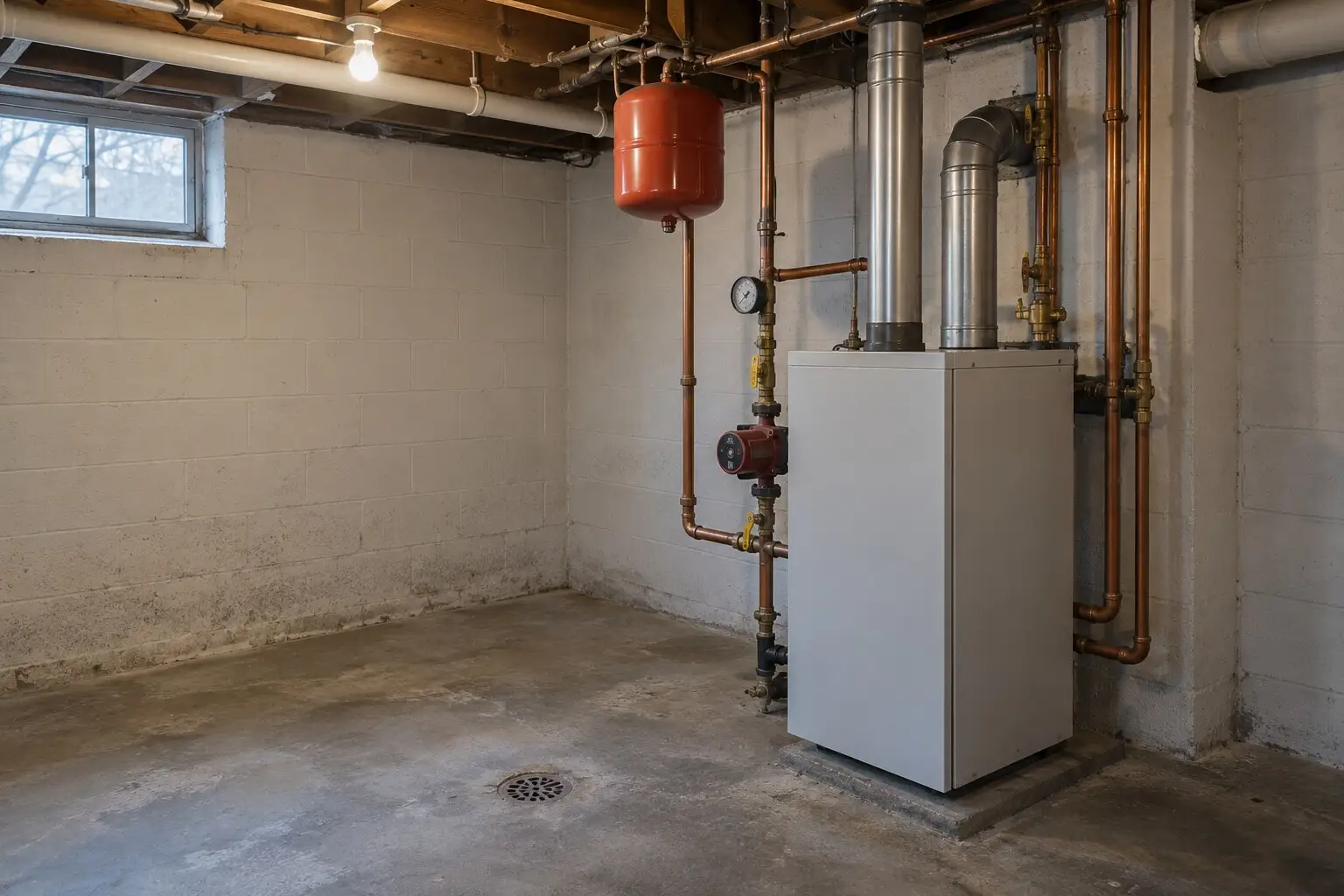
13.7 percent of the township dates to the 1950s and 12.8 percent to the 1960s, mostly in and around Lenola. That cohort was built with copper fin-tube baseboard on a boiler rather than the cast iron of the older core, which changes what a repair looks like: the element itself corrodes and clogs, the circulator is a wear item, and the expansion tank is usually the part that has been ignored longest.
New construction that was never balanced
A 2000s house here typically runs two systems, one per floor, and they are commissioned as a pair or not at all. Where the airflow was never measured and the charge was never verified against superheat and subcooling, both systems work but neither performs, and the owner concludes the house is simply hard to heat. Commissioning readings on a system this young are usually the whole diagnosis.
Oil tanks that never left
Only 1.6 percent of Moorestown homes still burn fuel oil, so a tank found during a replacement is usually a leftover rather than a working system. Whether it is above ground in the basement or buried in the yard changes what has to happen with it, and it is a question that belongs at the survey stage of a conversion rather than on the day the old equipment comes out.
How the system in a Moorestown house is laid out
AC repair Moorestown, NJ and winter no-heat work
One township holds two mechanical worlds. Around the Main Street historic district the air conditioning repair Moorestown owners ask about is retrofit work, high-velocity tubing or ductless heads, because the radiator houses were never ducted and cooling arrived long after the building did. On the 2000s edges it is one of two air handlers, and furnace repair Moorestown sees there means finding which half of a paired system is failing while the other keeps its floor comfortable. Both are worked by the providers listed on the corridor coverage page.
Services available in Moorestown
- Furnace and Boiler RepairA house that will not hold temperature, diagnosed on the equipment you actually have.
- Furnace and Boiler ReplacementReplacing equipment that has aged out, including oil-to-gas conversions and venting.
- Central Air InstallationCooling for houses that already carry ductwork, sized and commissioned to measurement.
- Ductless Mini Split InstallationCooling and supplemental heat for houses built around a boiler, with no ducts to use.
Areas covered for HVAC in Moorestown
HVAC Moorestown coverage runs the length of Moorestown Township and the blocks either side of it, including Moorestown-Lenola, the Main Street historic district, Bortons Landing, North Bend, Stanwick and West Moorestown.
Frequently Asked Questions
- Can a Moorestown radiator house get central cooling without losing the radiators?
- Yes, and keeping the boiler is usually the right call because the two systems are independent. A high-velocity air system runs small tubing through closets and joist bays to two-inch outlets, which is the common route in a finished historic house. Ductless heads are the alternative where the floor plan does not offer a path for tubing. In both cases the heating system stays exactly as it is and carries the winter.
- What does the historic district review cover on a mechanical job?
- It concerns what is visible from the public way rather than what happens inside the house. That normally means the position of an outdoor condenser, any line set running on an elevation, and vent terminations through a street-facing wall. Placement worked out before equipment is ordered avoids the situation where a system is sized correctly but cannot be installed where the design assumed it would sit.
- My baseboard is warm at one end and cold at the other. Why?
- On a fin-tube loop the water gives up heat as it travels, so a long run naturally cools along its length, but a large difference usually means restricted flow. The common causes are air trapped in the loop, fins bent flat or packed with dust so they cannot transfer heat, and a circulator that is failing. Bleeding, cleaning and a flow check separate those quickly.
- How do I know a new two-zone system was commissioned properly?
- Ask for the numbers. A commissioned system has recorded airflow per zone, static pressure across each air handler, and superheat and subcooling readings taken against the manufacturer's target for the outdoor conditions on the day. A contractor who took those readings will have them. Where no numbers exist, the system was set by feel, and that is where most performance complaints on new construction come from.
- Is a buried oil tank a problem during a conversion?
- It becomes one if it is ignored. An underground tank that is out of service has its own decommissioning process in New Jersey, and it is a documented issue at resale. The practical step is establishing during the survey whether a tank exists, where it is, and what condition it is in, so that the conversion and the tank are handled as two planned pieces of work rather than one surprise.