

What HVAC Haddonfield, NJ work runs into
Haddonfield is a 2.84 square mile borough on Kings Highway with a PATCO Speedline station in the middle of it, and in 1971 it became the second municipality in New Jersey after Cape May to establish a historic preservation district.
Of 4,470 housing units, 50.1 percent were built before 1940 and a further 18.5 percent in the 1950s. The borough is 83.2 percent owner-occupied and 80.8 percent detached, and 5.5 percent of it still heats with fuel oil against 2.1 percent in Cherry Hill.
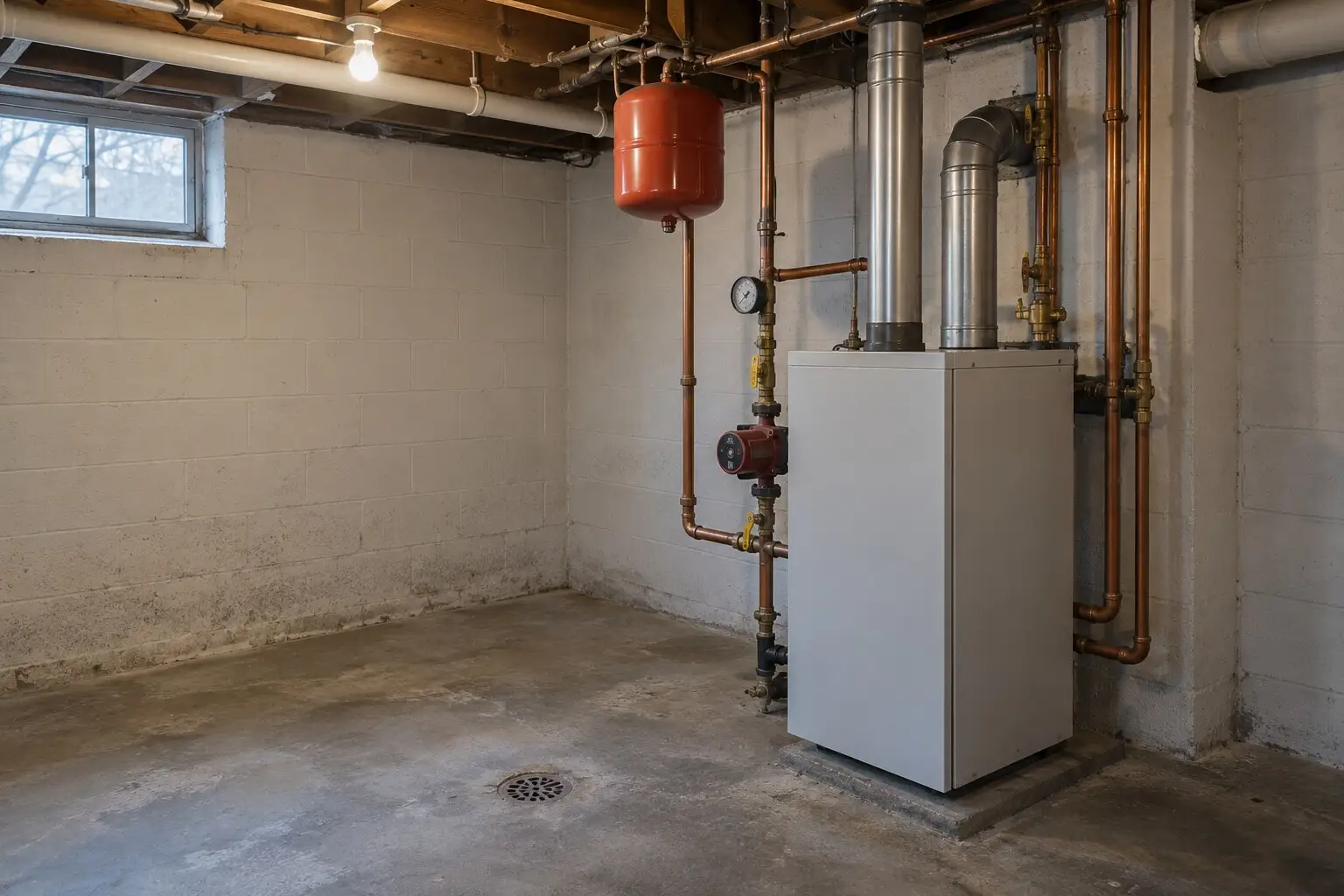
A house that predates 1940 has usually carried three fuels through one distribution system. Coal gave way to oil and oil to gas, and each conversion changed the appliance in the basement while leaving the radiators, the pipe and often the chimney exactly where they were. Most of what goes wrong here is at the joints between those eras.
Before a technician reaches Haddonfield
- Smell of gas: leave the building, then call the utility emergency number from outside.
- Confirm the thermostat has power and is calling for the mode you expect.
- Pull the filter. A blocked one shuts many systems down on a safety limit.
What shapes HVAC service in Haddonfield
Steam and hot water are different systems
Both use cast iron radiators and both look similar from the hallway, but they fail in unrelated ways. A one-pipe steam system depends on air vents and correct pitch, and a banging pipe usually means water sitting where steam needs to travel. A hot water system depends on a circulator, an expansion tank and a loop with no air trapped in it. Diagnosing one as though it were the other wastes a visit.
An oversized chimney after conversion
The masonry flue that vented a coal or oil appliance was sized for that appliance. When a modern boiler vents through a sidewall, the water heater can be left as the only thing on a flue far too large for it, where flue gases cool, condense and attack the liner. A correctly sized liner is the fix, and it is a question that belongs in the quote rather than in the following winter.
Cooling has to arrive some other way
There is no ductwork in most of these houses and there is no space to run conventional ducts through finished plaster without losing rooms. High-velocity tubing and ductless heads are the two realistic routes, and the choice turns on the floor plan, the position of closets and chases, and where an outdoor unit may sit. Nationally 26 percent of homes use individual room units, in New Jersey it is 42 percent, and this is why.
A pre-war house has a pre-war electrical service
Adding a condenser and an air handler to a house that has never had cooling adds a substantial electrical load. Where the service is 100 amps and already carrying a modern kitchen, that load has to be accounted for rather than assumed. It is a normal part of specifying a retrofit in this borough and it is much less expensive to discover during the survey than after the equipment is on site.
How the system in a Haddonfield house is laid out
AC repair Haddonfield, NJ and winter no-heat work
Almost everything here follows from the absence of ductwork. The air conditioning repair Haddonfield owners call about is usually a ductless head or a high-velocity air handler added decades after the house was built, not a conventional split system, and the fault list is different in both cases. Furnace repair Haddonfield is really boiler work: steam and hot water look alike from the hallway and fail in unrelated ways, so the arrangement of the pipe at the appliance matters more on the call than the symptom in the room. How cooling reaches houses like these is covered on the air conditioning Cherry Hill NJ page.
Services available in Haddonfield
- Furnace and Boiler RepairA house that will not hold temperature, diagnosed on the equipment you actually have.
- Furnace and Boiler ReplacementReplacing equipment that has aged out, including oil-to-gas conversions and venting.
- Central Air InstallationCooling for houses that already carry ductwork, sized and commissioned to measurement.
- Ductless Mini Split InstallationCooling and supplemental heat for houses built around a boiler, with no ducts to use.
Areas covered for HVAC in Haddonfield
Providers take HVAC Haddonfield calls across Haddonfield Borough and the surrounding streets, including the Kings Highway historic district, Haddon Avenue, Grove Street, Crows Woods, the blocks around the PATCO station and Mountwell.
Frequently Asked Questions
- How do I tell whether my Haddonfield radiators run on steam or hot water?
- Look at the radiator itself. A steam radiator has a single pipe entering at the bottom and a small metal air vent on the side near its upper edge. A hot water radiator has pipes at both ends and a small manual bleed valve at the upper corner instead of a vent. The boiler gives the second answer: a steam boiler carries a sight glass showing a water line, a hot water boiler carries a pressure gauge reading in the tens of pounds.
- Which is better for a pre-1940 house, high velocity or ductless?
- Neither is better in general and both work here. High-velocity keeps the visible hardware down to small round outlets and suits a house with usable closets and chases for the tubing, though it needs a place for the air handler. Ductless needs only a small penetration per head and no run at all, but each head is visible in the room. The floor plan usually settles it once someone has walked it.
- Do the radiators have to come out if I add cooling?
- No. Heating and cooling stay as separate systems in this kind of retrofit. The boiler and radiators keep carrying winter exactly as they do now, and the cooling equipment is added alongside them with its own distribution. Removing a working hot water system to make room for a forced-air one is a much larger job with no comfort benefit in a house that was designed around radiant heat.
- What does the historic district have to say about an outdoor unit?
- Its interest is in what is visible from the street rather than in the equipment itself. Position on a side or rear elevation, screening, and the route any line set takes across a facade are the points that come up. Working the placement out early is worth doing, because a condenser has clearance requirements of its own and the two constraints have to be satisfied at the same time.
- Is a 100 amp service enough for central cooling?
- Sometimes, and it has to be calculated rather than guessed. The load calculation adds the compressor and air handler to whatever the house already draws and compares the total against the service. Where it does not fit, the options are a service upgrade or equipment with a smaller electrical demand, and ductless systems often help because they draw less than a comparable central system.