

The replacement wave this corridor is in
Thirty-one percent of main heating equipment in the Middle Atlantic division is twenty years old or more, and another thirteen percent is between fifteen and nineteen. Housing here lines up with that. Cherry Hill put 64 percent of its stock up between 1950 and 1979, Pennsauken 28.4 percent in the 1950s alone, Cinnaminson 31.9 percent in the 1960s. None of those houses is on its original heating plant, but a great many are on the one installed two owners ago.
That is the practical trigger for most heating system replacement Cherry Hill NJ work sees, and it arrives on a schedule rather than as a surprise. The nameplate carries a date, or a serial that decodes to one, and knowing it turns a future emergency into a planned job that can be done in September rather than in January.
Sizing is a calculation, not a copy
The single most common fault in a furnace installation, and in a boiler replacement equally, is matching the output of the equipment being removed. Systems installed decades ago were routinely oversized, and copying the rating carries that error into the new one. An oversized furnace satisfies the thermostat quickly, shuts off, and repeats, which produces uneven rooms, more wear on ignition components and worse humidity control than a correctly sized unit running longer cycles.
A heat loss calculation works from the building as it stands: wall and attic insulation, window area and type, air tightness, and the 14 °F winter design condition this part of New Jersey is sized to. On a house that has had windows or insulation upgraded since the last replacement, the correct answer is frequently smaller than what is being removed.
Venting is where the surprises live
A high-efficiency furnace replacement cannot use a masonry chimney, because its flue gases leave cool enough to condense inside it. It vents through a sidewall in plastic pipe and drains its condensate, which is straightforward on most houses here. What it leaves behind is the question worth asking: if a natural draft water heater was sharing that chimney, it is now alone on a flue sized for two much larger appliances, and it needs a correctly sized liner.
Boiler replacement raises the same point from a different direction. The radiators, the baseboard and the mains are the durable part of a hot water system and stay in place, so the work concentrates at the appliance, the near-boiler piping and the controls. That is why replacing a boiler in Haddonfield or Collingswood disturbs far less of the house than owners expect.
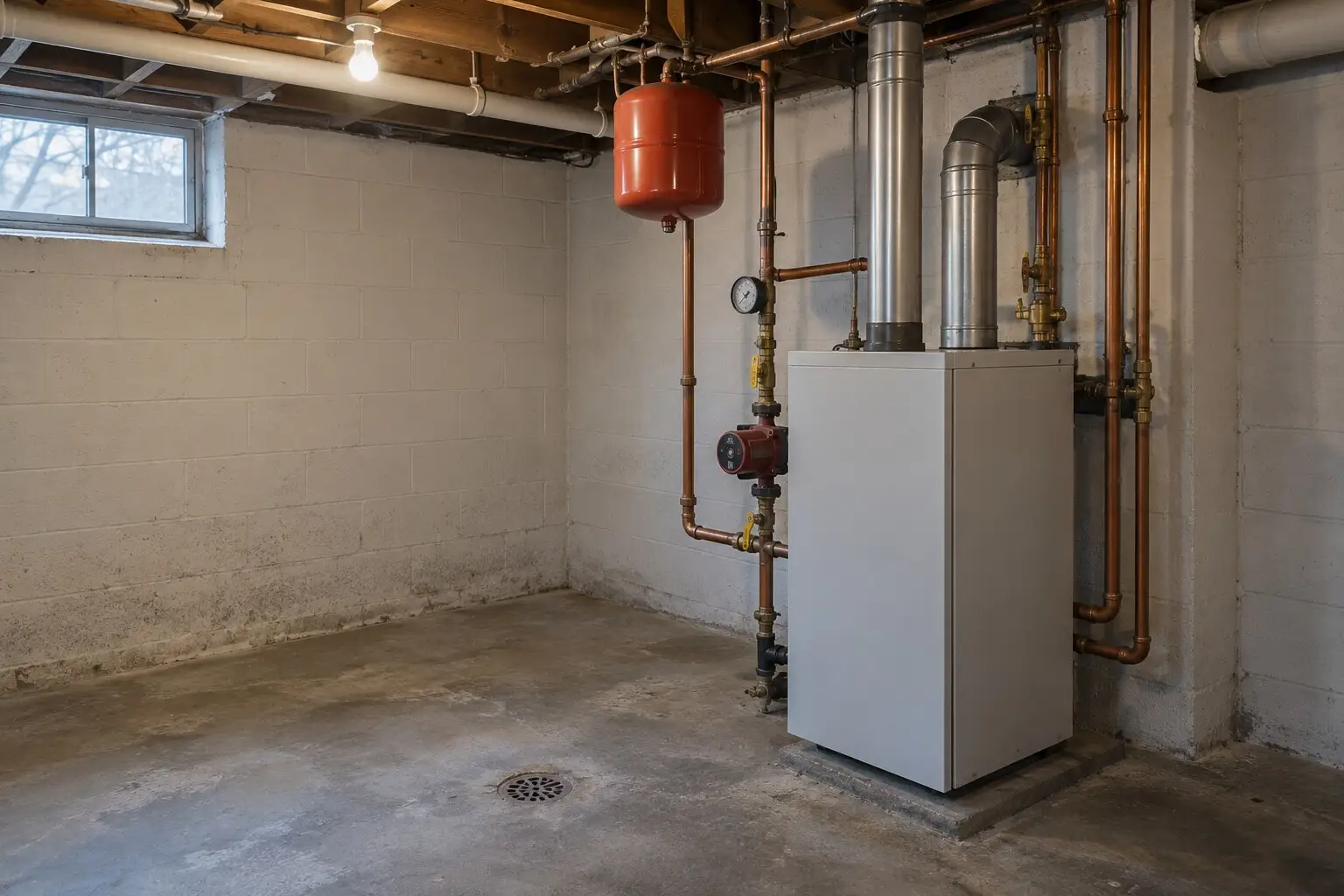
Off the gas main, the decision changes shape
Medford still heats 6.5 percent of its homes with fuel oil and 1.8 percent with bottled propane, and Pennsauken 4.3 percent with oil. Where there is gas at the road, a conversion is an appliance change. Where there is not, the utility prices the main extension by distance and that number usually decides the job on its own. The honest comparison at that point is between a new oil appliance, a propane installation with its tank and supply contract, and an electric heat pump sized for this climate.
Cooling is a separate decision in a boiler house and is covered on the ductless mini split page. In a ducted house it shares the equipment, and the sizing and commissioning side of that sits on the central air installation page.
Replacement coverage along the corridor
- Heating Replacement Cherry HillCherry Hill Township · ZIP 08002, 08003, 08034
- Heating Replacement VoorheesVoorhees Township · ZIP 08043
- Heating Replacement MarltonEvesham Township · ZIP 08053
- Heating Replacement Mount LaurelMount Laurel Township · ZIP 08054
- Heating Replacement MoorestownMoorestown Township · ZIP 08057
- Heating Replacement MedfordMedford Township · ZIP 08055
- Heating Replacement HaddonfieldHaddonfield Borough · ZIP 08033
- Heating Replacement CollingswoodCollingswood Borough · ZIP 08108
- Heating Replacement PennsaukenPennsauken Township · ZIP 08110, 08109
- Heating Replacement CinnaminsonCinnaminson Township · ZIP 08077
Frequently Asked Questions
- How old is too old?
- Heating system replacement Cherry Hill NJ homeowners plan rather than react to starts from the nameplate. A gas furnace commonly runs fifteen to twenty years and a boiler often longer, with installation quality mattering as much as the badge. The useful number is not the age of the house but the date on the nameplate, which the serial usually decodes to. Thirty-one percent of main heating equipment in this census division is twenty years old or more, so a house that has never had a documented replacement is very likely in that group.
- Does a new boiler mean new radiators?
- No. The distribution is the durable half of a hot water system and it routinely outlives several boilers. A replacement changes the appliance, the controls and usually the near-boiler piping, while the baseboard, the radiators and the mains stay where they are. That is one reason boiler replacement in the older boroughs is less disruptive than owners expect it to be.
- What is a chimney liner and why does it appear in the quote?
- A modern condensing appliance vents through a sidewall in plastic pipe because its flue gases are too cool for masonry. If the water heater was sharing that chimney it is then alone on a flue sized for two much larger appliances, where the gases cool, condense and attack the masonry. A correctly sized metal liner fixes it, and it belongs in the quote rather than in the following winter.
- How is the replacement sized?
- By a heat loss calculation on the actual building, not by the capacity of whatever is being removed. The equipment coming out was frequently oversized to begin with, and copying its rating carries that error forward into a system that short-cycles and never runs long enough to be comfortable. Insulation, window area, air tightness and the 14 degree Fahrenheit winter design condition for this area are what the calculation uses.
- Is an oil-to-gas conversion worth doing?
- It turns on one question: whether the gas main already runs past the property. Where it does, the conversion is a normal appliance change plus venting and a liner. Where it does not, the utility charges for the main extension by distance and that figure regularly decides against it. Ask for that number first, then compare a new oil appliance, propane and an electric heat pump against it.
- Does the work need a permit?
- Yes. Heating and cooling replacement is regulated work under the New Jersey Uniform Construction Code, and the municipal construction office issues the permit and inspects the installation. The contractor normally files it. Confirming that they are doing so is worth a sentence, because the inspection is the only independent check that venting, gas piping and combustion air were done correctly.